Graduate Student · Stanford · SAIL
Muhammad
Ahmed Mohsin
Co-advised by Dr. Emily Fox and Dr. John M. Cioffi
Research on preference optimization and alignment for LLMs, adaptive test-time scaling and discovery, and self-evolving multi-agent systems.
Graduate student at Stanford — LLM post-training, test-time scaling, and reinforcement learning. Collaborations with Google DeepMind, Meta, Amazon AGI, and Microsoft Core AI.
Research Interests
My research spans preference optimization and test-time scaling for LLM reasoning, agentic system architectures and coding agents, and AI alignment and benchmarking — with collaborations across Google DeepMind, Meta, Amazon AGI, and Microsoft Core AI.
Preference Optimization and Test-Time Scaling
Post-training · Inference-time searchDesigning sample-efficient preference-learning and reinforcement-learning methods for aligning language-model reasoning, and adaptive test-time compute methods that dynamically control inference depth, tool invocation, and verification under strict budgets. I am interested in how post-training and inference-time search jointly shape reasoning, and in principled trade-offs among accuracy, latency, and reliability.
Agentic System Architectures and Coding Agents
alexein.ai · Amazon AGIBuilding agentic systems that plan, act, and self-verify over long horizons, spanning multi-agent coordination and the software agents I develop at alexein.ai. Through my work at Amazon AGI on coding agents, I study how agents convert test-time compute into solved tasks by exploring diverse solutions and writing trustworthy verifiers, and how these behaviors can be internalized through supervised and reinforcement post-training.
AI Alignment and Benchmarking
Alignment · EvaluationDeveloping persona-based benchmarks and user-simulation frameworks that evaluate how models behave across diverse populations and interactive settings. I am broadly interested in AI alignment, including calibrated uncertainty and reducing sycophancy, and in measurement methodology that makes alignment progress observable and reproducible.
Experience
Amazon AGI
Jun 2026 – Sep 2026
Myeongsoo Kim
Teaching Agents to Code Reliably (ICLR 2027)
- —Ran a controlled study of six test-time strategies on a fixed Qwen3-Coder-30B agent over SWE-bench Verified, isolating diversity of exploration and diversity of edits as the skills that convert compute into solved bugs, and showing that self-authored verification sits near chance.
- —Distilled diverse, reactive search into the policy via weighted supervised fine-tuning (pass@1 31.8 → 35.1, pass@8 46.8 → 51.2), then trained a discriminative self-verifier with GRPO using a mutation-gauntlet reward with step-level, threshold-free credit.
Stanford Artificial Intelligence Laboratory (SAIL)
Sep 2025 – Present
Prof. Emily Fox
Internet of Evolving Agents
- —Co-developed a modular multi-agent ecosystem where autonomous agents evolve their capabilities, reputation, and social connections over time through Bayesian reputation updates, dynamic team formation, and social graph evolution. The framework enables emergent specialization and self-organizing collaboration for complex task execution (NeurIPS 2026, in progress).
Test-Time Compute and Reasoning in Large Language Models
- —Submitted work on adaptive test-time compute allocation for LLM reasoning, focusing on dynamic control of inference depth, tool invocation, and verification under strict compute budgets, and analyzing principled trade-offs among accuracy, latency, and reliability.
Bayesian Preference Alignment for Mathematical Reasoning
- —Developed active learning frameworks for Bayesian General Preference Models and CU-DPO to align small language models for mathematical reasoning, enabling sample-efficient preference learning with calibrated uncertainty (ICML 2026, CoLM 2026).
Intel Corporation
Sep 2024 – Dec 2024
Dr. John M. Cioffi
Neural Gaussian Radio Fields for Environment Perception
- —Developed a 3D computer vision-based channel estimation framework for next-generation wireless networks, implementing a CUDA-based differentiable real-time pipeline achieving 1 ms inference latency (KDD 2026 submission).
Samsung Semiconductors
Jun 2024 – Sep 2025
Dr. John M. Cioffi
Graph Neural Networks for Accelerating Low-Rank SDP Solvers
- —Developed a constraint-graph representation of SDPs with a Graph Attention Network encoder to predict rank trajectories, integrating learned rank schedules into low-rank solvers to eliminate manual heuristics and achieve up to 3× speedups on large-scale benchmarks (JMLR 2026).
Selected Publications
Active Alignment with Bayesian General Preference Models
M. Umer*, M. A. Mohsin*, A. Bilal, E. Vitercik, J. M. Cioffi
Coverage Preservation in RL as an Off-Policy Constraint
M. A. Mohsin, M. Umer, A. Bilal, J. M. Cioffi, E. Fox
Teaching Agents to Code Reliably
M. A. Mohsin*, M. Kim, K. Ruan, S. Garg, V. Kumar, M. K. Ramanathan
Conference Travels
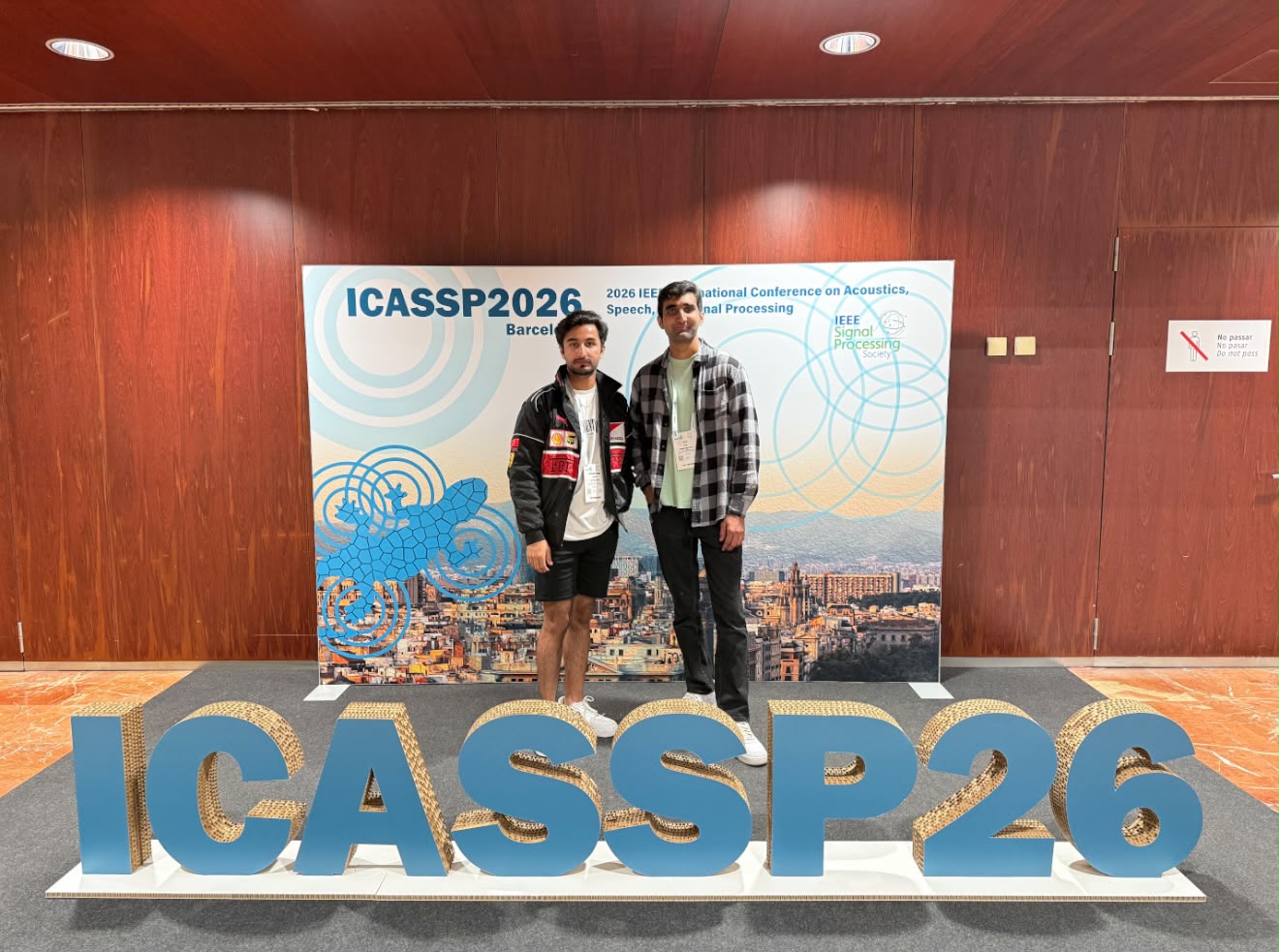
IEEE ICASSP 2026
Barcelona, Spain
Presenting work on diffusion models and non-stationary channel estimation
News
Knight-Hennessy Fellowship finalist.
Served as an Area Chair for ICASSP and NeurIPS 2025.
Selected as a Qualcomm Fellowship finalist.
Serving as Workshop Co-Chair for VTC Fall 2026 in Boston.
Served as a member of the Technical Program Committee at NeurIPS 2025 and also as a NeurIPS reviewer.
Received the Exemplary Reviewer recognition for IEEE Wireless Communications Letters 2025.
Added as a founding member of the IEEE Special Interest Group on AI-driven TN-NTN Networks.
Paper accepted at ICML 2025 on "Continual Learning for Wireless Channel Estimation," along with a student travel grant to ICML.
Received an ICC student travel grant for Montreal and a best workshop paper award for RAG-optimized wireless environment perception.
Two papers on Hierarchical Deep RL and Joint Source Compression accepted at AAAI 2025 in Philadelphia.
Two papers on diffusion-based Langevin dynamics and minPMAC optimization accepted at IEEE ICASSP 2025 in India.
Awarded a Globecom 2024 travel grant for travel to Cape Town.
Received a Best Poster Award nomination at the 6G Summit in Abu Dhabi.
Awarded the Rector's Gold Medal for best undergraduate thesis.
Accepted to Stanford with the Stanford Graduate Fellowship.
First paper accepted at ICDAR 2023, outperforming Microsoft's DiT on table recognition tasks.
Received the ECAT Scholarship for ranking among the top 10 in Pakistan in the engineering category test.
Received the President's Medal for ranking among the top 3 students across Pakistan at the HSSC level.
Awarded the NUST scholarship for maintaining a 4.0 GPA.
Service & Awards
Conference Reviewer
Journal Reviewer
Technical Program Committee
Leadership
Awards & Recognitions
—Stanford Graduate Fellowship
—Qualcomm Fellowship
—Knight-Hennessy Fellowship — Finalist
—President's Medal — Third position nationwide in pre-engineering
—6G Summit Abu Dhabi — Best Poster Nomination
—IEEE ICC Canada — Best Workshop Paper Award
—IEEE Communications Society Competition — Honorary Mention
—IEEE FIT 2026 — Best Main Conference Paper Award
—Rector's Gold Medal — Best final year project cohort (NUST, 2024)
—HSSC Federal Board Scholarship (PKR 200,000)
—STEP-ECAT Scholarship — Top 10 engineering candidates nationwide (PKR 200,000)
Travel Grants
Get in Touch
I am always open to discussing new research collaborations and opportunities.